
Zhigang Ye
Map Without Treasure, 2025
Map Without Treasure is a single piece in project I Wish You Were Here (2025), which involves various processes of presenting and finding undefined or captured subjects in an image.
Map Without Treasure begins with an out-of-focus portrait: the two figures in the frame remain present, yet can no longer be recognised as concrete forms. The image behaves, in media philosopher Vilém Flusser’s terms, as a technical image – not a representation of the world, but the output interface of an apparatus and its programme, a two-dimensional surface that must be “decoded”, a map rather than a window.
I developed a pipeline to track and probe how machine vision senses and defines “the subject”. The algorithm draws on contrast and edges, attention weights inside deep networks, and reconstruction error to locate those parts of the image that are “hard to predict”, and outputs thousands of coordinate points (x, y). Taken together, these points form a continuous field of “subjectness density”: in some zones the model’s attention is highly condensed, while in others it is thin, drifting and intermittent. This coordinate field is then passed into a generative visualisation process. According to the weights, intensities, and spatial relations of the points, the system produces networks, colour clusters, and diagrammatic overlays, which are reinserted into the original portrait. The result is not a clarified image, nor an act of identification. Instead, the work produces a speculative cartography of attention: a map of where the image, the machine, and the viewer begin to search for a subject that can no longer be securely located.
As media theorist and artist Joanna Zylinska has argued, what we call “the subject” is not something that is there a priori, but something that is temporarily sketched and thickened by a set of observational technologies and algorithmic forms of attention.In persistently asking “Where is it?”, the concealed subject emerges from its background. In the act of looking, how do we sense and search, even when there is no so-called treasure on this map? It is precisely this process that the work stages and reflects on.
Map Without Treasure, 2025. C-type print on Fuji glossy paper, 90 × 120 cm (variable).
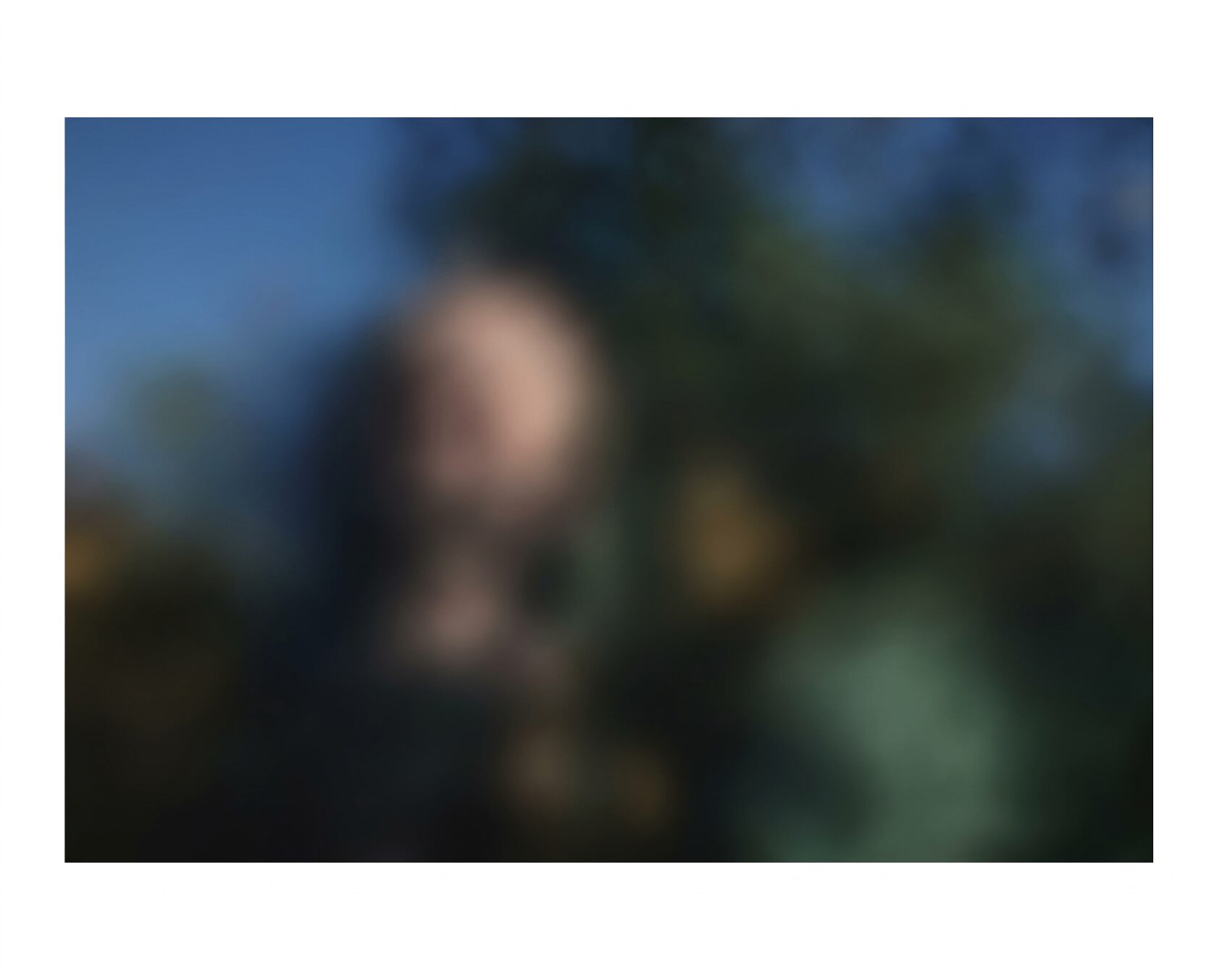
Out-of-focus portrait, 2023, HangZhou, China
Map Without Treasure visualises not only an image, but a mechanism of searching. The blurred portrait is marked, sampled, and repeatedly passed through algorithmic procedures, until it becomes connected into a web of machine attention. Yet by watching how the machine searches for the subject, the viewer also becomes aware of their own uncertainty and bewilderment in relation to what is being sought. The work does not simply ask where the subject is; it asks how the desire to find a subject is itself produced, externalised, and mapped.
This displacement of attention also unsettles the assumed stability of the human observer. As philosopher Jacques Derrida suggests, the question is not only whether nonhuman beings can be denied capacities such as language, technics, or culture, but whether “the human” can securely claim these capacities as its own. Similarly, French psychoanalyst Jacques Lacan’s reflections on cybernetics suggest that the lesson of the machine is not that the machine becomes human, but that the human is less securely human than it imagines. Map Without Treasure does not anthropomorphise machine vision. Rather, it uses machine attention to reflect on how searching, interpretation, uncertainty, and desire are not exclusively human operations, but conditions distributed across technical and perceptual systems.

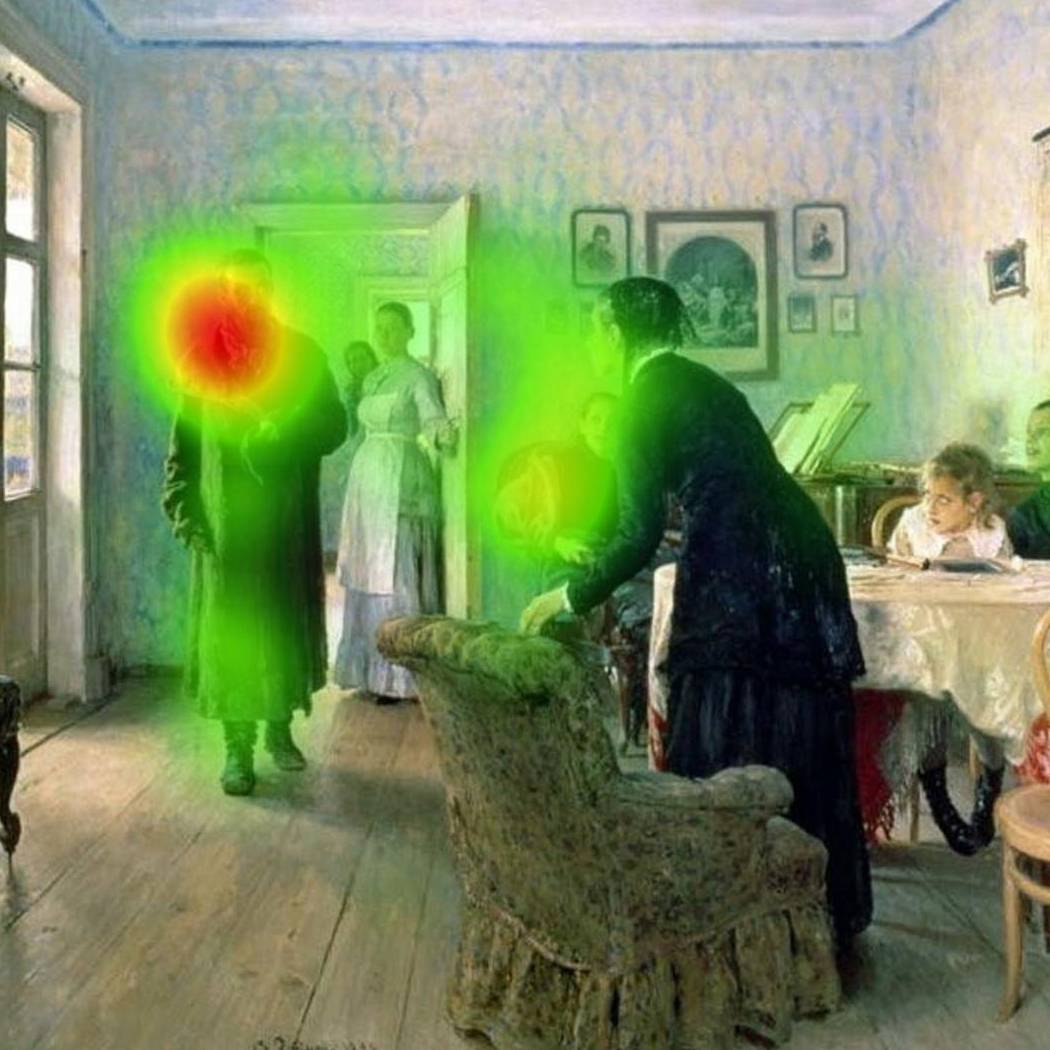

Eye-movement scanpath over Ilya Repin’s They Did Not Expect Him, after Alfred L. Yarbus (1967).
The process and final visual effects of Map Without Treasure also recall soviet psychologist and vision researcher Alfred L. Yarbus’s eye-tracking experiments of the 1960s, in which he asked subjects to look at paintings and then overlaid their fixations and saccadic paths onto the image. Yarbus’s experiments showed that viewing is not passive reception, but is organised by tasks, questions, desire, and problem-consciousness. In Map Without Treasure, this logic is displaced from the human eye to the computational image. Viewing, whether human or machinic, is included within the process of mapping. Both are organised by the task of searching for something that is not immediately available. The image is therefore not only constructed, but also given through the conditions of looking.
This logic continues across other works in I Wish You Were Here, including Should be in this corner (2025), Park (2025), La barba del diablo in subway station (2025), and Having a Holiday (2025). In these works, I ask a generative model to produce a version of an existing photograph with an added spider or spider web. Although the technical logic of generation does not literally reproduce the temporal process of looking, the resulting images nonetheless register an embedded mode of viewing. The model must infer where a web might plausibly appear, how it would attach to surrounding structures, and how lighting, geometry, depth, and orientation would condition its appearance.


Fig. 1. Park (2025). Fig. 2. La barba del diablo in subway station (2025). Fig. 3. Having a Holiday (2025).
In Should be in this corner, for example, the judgement of where the web and spider ought to exist is effectively handed over to the machine and written back onto the photograph. What appears is not only an inserted motif, but a trace of the system’s visual understanding of the original image. Likewise, in Park and La barba del diablo in subway station, the generated web does more than decorate the image. It reveals how the model parses the forked structure of a tree, or the perspectival and luminous order of a station. In Having a Holiday, the generative system attempts to negotiate the spatial arrangement of stones on a beach without any explicit programmatic template. These understandings emerge not as explanation, but as visual manifestation.
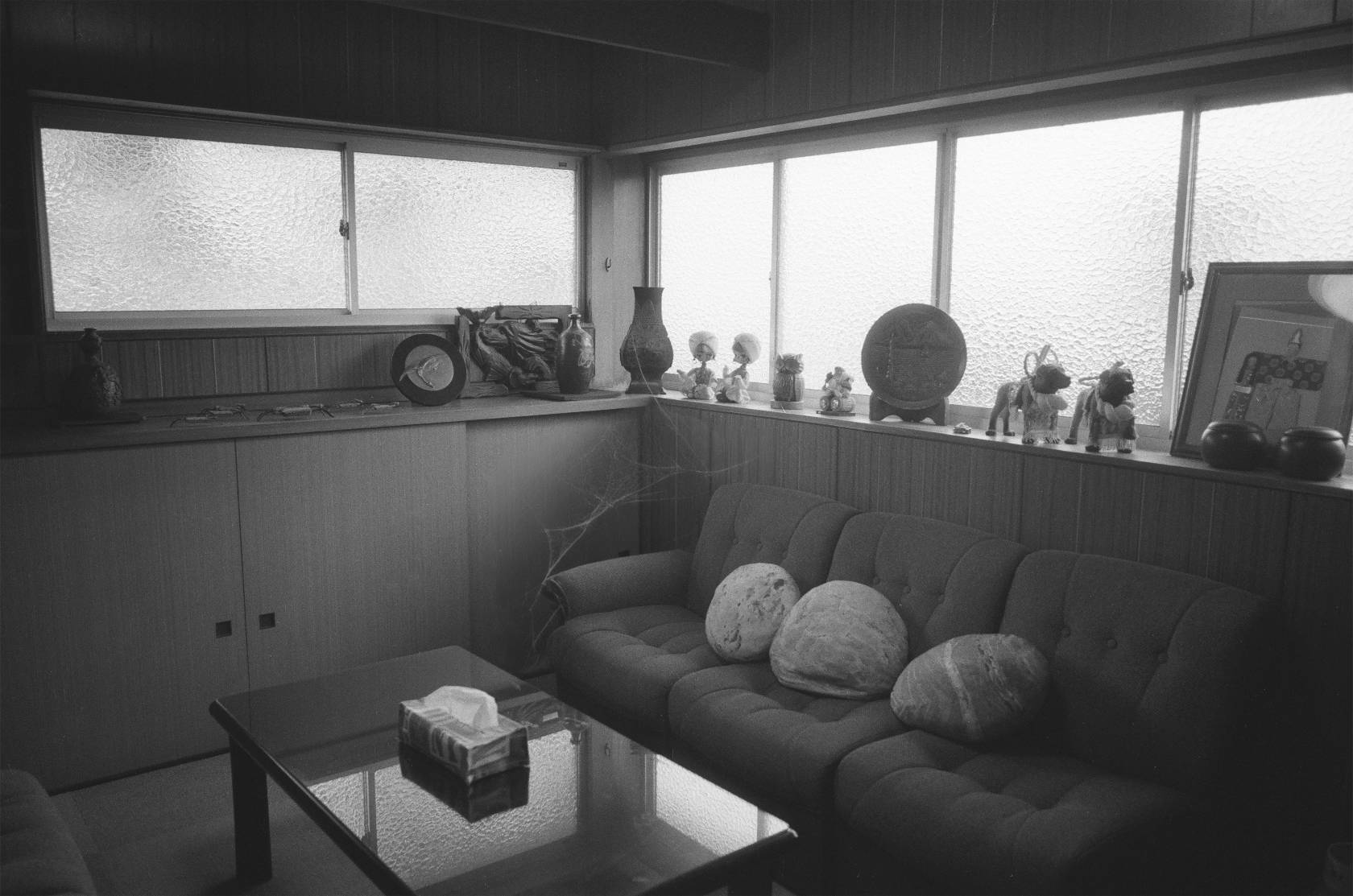
Should be in this corner, 2025. C-type print on Fuji glossy paper, 18 × 24 cm (variable).
This is not the same as organic thought in the human sense. Yet neither is it merely arbitrary. What generative image systems organise is a statistical field of visual possibility. The image is reduced to encoded relations, probable components, and possible configurations, from which new necessary possibilities are composed. These constraints constitute a form of internal attention: a mode of viewing that does not precede the image, but becomes visible through the image’s surface.
Across these works, viewing and construction occur at the same time. To ask where something should be is also to ask what that thing is, or can become, within the image. This is central to the wider logic of I Wish You Were Here: the spider is not simply absent, hidden, or waiting to be found. It is produced through the very procedures that search for it. In this sense, the project treats generative image-making as a way of visualising the unknown. The image becomes both the field of inquiry and the method through which inquiry takes place.
Looking back across the project, the most significant difference introduced by generative image production lies in its mode of givenness. If photography has long operated within a tension between construction and the given, generative systems redistribute that tension in new ways. Between user and device, prompt and output, intention and result, power is allocated differently. Map Without Treasure stages this redistribution through the problem of searching: not in order to find a final treasure hidden beneath the map, but to reveal how subjects, images, and acts of seeing are provisionally produced through the apparatuses that seek them.

Zhigang Ye is an artist and practice-led researcher working at the intersection of photography, art history, and generative images. He studied New Media Art at Taipei National University of the Arts and completed an MA in Photography at the Royal College of Art, where he is currently a PhD researcher. His practice explores speculative ethnography, existential thought, and media philosophy through contemporary image-making.